Hell’s Angels
Heart of the HunterHell’s Angels are presented as a motorcycle brotherhood that turns solidarity into practical support for Thobela Mpayipheli while he is being hunted. Their intervention is shown first through a radio appeal for information and then in person, when a large group reaches a police roadblock. The novel gives little account of the organization’s formal structure; instead, it defines the group through its members’ language of brotherhood, their distinction between committed riders and weekend enthusiasts, and the pressure their collective presence exerts on the authorities.
Identity and Brotherhood
The organization appears in the radio exchange as the Pretoria Chapter of Hell’s Angels. A member named Burt contacts the program to ask where Mpayipheli is, explaining that he is in trouble and is regarded as a brother. When the host challenges the basis for that claim, Burt describes motorcycle riders as belonging to a wider brotherhood and says that members help when one of their own is in difficulty. In this exchange, belonging is framed less as a question of a particular motorcycle club than as a responsibility among riders.
That expansive claim has limits. Burt later calls back to correct the host’s assumptions about motorcycle culture: not all Hell’s Angels ride Harleys, and the idea that Mpayipheli belongs to a BMW group is, in Burt’s view, false. He dismisses the latter riders as weekend enthusiasts and contrasts them with what he considers a genuine biker. The exchange makes the Angels’ solidarity selective in its own way: the group presents itself as a brotherhood, but also asserts standards of experience and identity that distinguish serious riders from outsiders. Mpayipheli earns Burt’s respect not through a stated club membership, but through his status as a war veteran and a road warrior.
The Radio Appeal
The radio conversation makes the chapter’s support visible while the authorities are trying to locate Mpayipheli. The Angels know that he was near Three Sisters at six that morning, but they do not know where he has gone since. Their call therefore does not demonstrate that they possess his location or have an established plan to reach him. It shows that they are trying to find out where he is and are willing to use a public broadcast to ask for help on his behalf.
The exchange also places the group’s account beside the official pursuit. The host asks how the Angels could help; Burt’s answer is deliberately open-ended, offering assistance in whatever way they can. The vagueness matters: the novel presents commitment before it presents a specific operation. In the later roadblock scene, that general promise acquires a concrete form. Their first contribution is not a detailed rescue plan but a visible show of numbers and resolve, making the riders themselves a force the authorities must take into account.
The Windsorton Road Roadblock
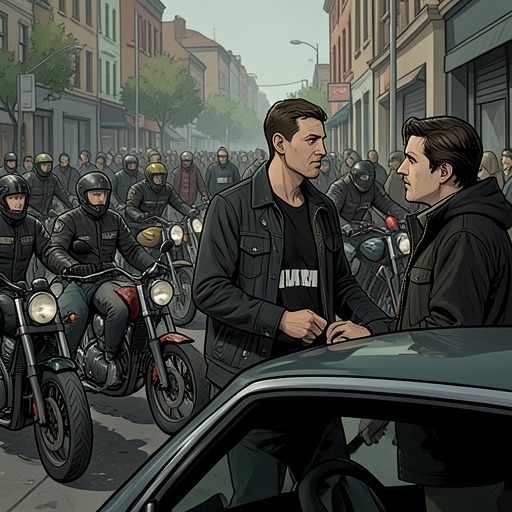
The scale of that intervention emerges when officials report that thirty-nine Hell’s Angels are waiting at the Windsorton Road roadblock and want to pass. The road is identified as forty-five kilometres north, on the N12. The situation escalates when officials add that another fifty riders are on their way. They warn that if the approaching group is stopped, the authorities may have to shoot them. The Angels’ presence thus changes the stakes of a routine attempt to control movement: refusing passage could turn the roadblock into a lethal confrontation.
Captain Tiger Mazibuko reconsiders the response and tells the colonel to let the riders through. The colonel relays that instruction to the sergeant, who acknowledges it. The scene records a consequential decision, not a fight: the Angels’ collective insistence on continuing is enough to make armed resistance appear too dangerous. The episode does not establish that the group and Mazibuko negotiate, or that the riders are given a specific destination. It does establish that their solidarity has immediate practical force, and that the pursuit of Mpayipheli is complicated by people prepared to stand together on the road.
Narrative Role and Limits of the Portrayal
Hell’s Angels offer a striking counterpoint to the official machinery of the manhunt. The authorities rely on monitoring, orders, and armed roadblocks; the bikers act through personal allegiance and a shared identity. Their willingness to support Mpayipheli rests on the claim that a rider in trouble is not to be abandoned. In the roadblock scene, that principle becomes a collective presence whose potential cost the authorities must weigh. The group is not shown changing the political or intelligence systems pursuing him, but it does interrupt their ability to act without regard for the people caught in the pursuit.
The organization’s portrayal remains focused on these episodes rather than on a full account of its membership, hierarchy, or wider activities. Its distinction between committed riders and weekend motorcyclists is expressed through Burt’s own emphatic, sometimes contemptuous radio language; it should not be mistaken for a neutral description of every rider or a comprehensive account of the club. What the narrative makes clear is narrower and more consequential: the Pretoria chapter recognizes Mpayipheli as a brother in the road’s wider community, tries to learn where he is, and arrives in numbers at a roadblock where its determination to pass helps prevent a possible shooting.